A Rainy-Day Film Watch for Setting Details
A rainy-day film watch trains your eye to track recurring background details, revealing how streets, rooms, and thresholds feel connected across scenes.
Which background detail keeps returning after a scene has moved somewhere else? A rainy-day film watch can help you spot the repeated objects, colors, and architectural features that make a screen setting feel like one connected place. Choose a film you can pause, a notebook, and one detail to follow; the exercise is less about identifying hidden clues than noticing what the setting quietly carries from scene to scene.
Choose one thread
Before pressing play, decide what kind of repeat you want to follow. A broad category can turn the watch into a scavenger hunt, so choose a visible thread with a clear identity: a green door, a strip of patterned wallpaper, a public clock, a particular kind of window, or a recurring patch of warm light.
For this exercise, “repeated” means recognizable across separate shots or locations, not merely several similar objects in one room. A blue enamel sign that appears in a station, a shop, and a hallway is easier to track than “blue things” throughout the film. Look for a feature you can describe in a few words and identify without guessing what it symbolizes.
Keep the first watch simple. Follow the film’s story normally and mark each clear appearance with a quick note: where it shows up, who is present, and whether the detail is near the camera or in the distance. Leave interpretations for later. A detail may be repeated because it belongs to the same location, because it links separate places, or because the camera keeps returning to it for another reason.
Pick something you can recognize at a glance, not a theme you have to infer.
Make a compact log
A useful viewing log is a record, not a transcript. You do not need to write down every cut or describe the entire frame. Note only the information that lets you compare one appearance with another.
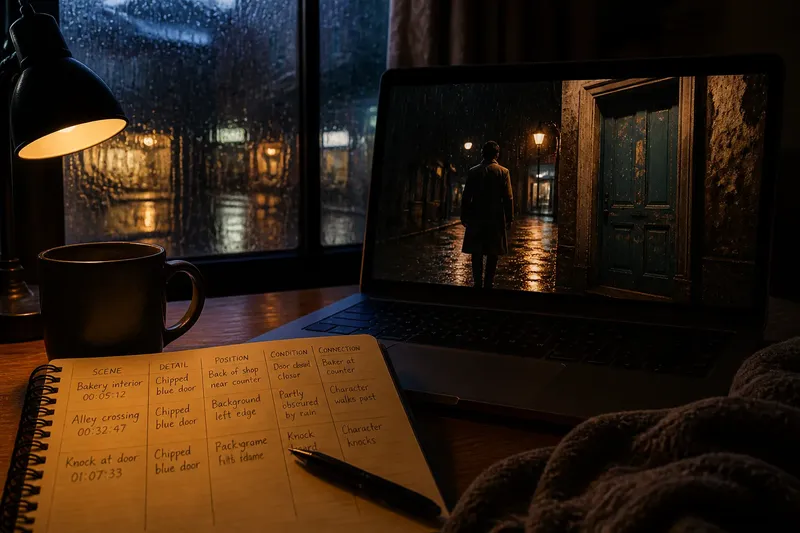
- Scene: Give the location a plain name, such as “apartment hall” or “corner store.”
- Detail: Record the feature precisely: “yellow notice behind the counter,” not simply “paper.”
- Position: Note whether it sits near a doorway, at the far end of the room, or along the edge of the frame.
- Condition: Mark visible changes, such as a door standing open, a lamp being lit, or a poster appearing torn.
- Connection: Note who enters, leaves, passes by, or looks toward the detail.
Use brief phrases rather than pausing for long descriptions. If the film moves quickly, write down only the location and detail, then revisit the scene later if the platform allows it. The point is to keep your attention on the screen rather than turning the watch into clerical work.
A small log can reveal patterns a memory-only watch tends to blur.
Separate the kinds of repeats
Not every recurrence connects places in the same way. Start by sorting what you saw into a few practical categories. An exact repeat is the same identifiable feature seen again, such as the same cracked tile or sign. A designed echo is a related feature that varies: several rooms may share the same narrow windows, dusty red paint, or globe-shaped lamps.
A third kind is a route marker. This is a detail that helps the viewer understand movement through a place: a stairwell landing, a mural beside an exit, or a distinctive shopfront on a street characters cross more than once. It may not carry story information on its own, but it can make a return visit legible.
Keep these categories separate in your notes. If a film shows matching brass handles in several rooms, that may suggest a consistent design language; it does not mean every room is physically connected. If the same hand-painted sign appears in two scenes, check whether the film has returned to one location or shown a copy elsewhere. The shot alone may not settle that question, and you do not need to force an answer.
Ask what the repeat lets you recognize before asking what it means.
Notice the frame around it
Background details work in relation to the camera. The same window can feel like a stable landmark in a wide shot, a hazy shape behind a conversation, or a narrow strip glimpsed during a moving shot. Record the framing as well as the object: visible throughout the scene, briefly revealed, partly blocked, or kept close to a character.
Then notice whether the detail changes with the scene. A familiar hallway might be brightly lit on one visit and nearly swallowed by shadow on another. A chair may remain in its usual place while the people around it change. These shifts can make a setting feel occupied and responsive rather than like a collection of fixed decorations.
Imagine you are following a chipped blue door in an invented film. It appears first in a wide shot of a bakery, then briefly behind a character crossing an alley, and later in a close view as someone knocks. Your log shows that the door’s shape and damage remain recognizable, while the camera gives it more attention each time. You could describe the observable effect as increasing emphasis; claiming that the door represents a particular memory would go beyond what the images alone establish.
When in doubt, describe placement and change before assigning meaning.
Read transitions and returns
Repeated details are especially useful at scene boundaries. Watch what appears immediately before a cut and what greets you after it. A sign, window, or line of streetlights may carry the eye into a new scene, making a change in location feel continuous. Alternatively, a sharp change in the familiar detail can make the new scene feel like a disruption.
Pay attention to returns, too. When characters come back to a place, does the film show the same background feature from the same angle, or reveal a new corner? A repeated view can establish familiarity; a changed view can suggest that the place has been re-entered under different circumstances. Neither effect depends on the detail being a symbol. The viewer may simply be learning the geography through repetition.
Notice sound alongside the image, but keep the two observations distinct. Rain against a window, a train heard beyond a wall, or a shop bell can make locations feel related even when the visible details differ. If you chose an object to track, log the sound separately rather than treating it as another appearance of that object.
On a second pass, watch the cut that brings the detail back.
Questions to carry along?
What counts as a recurring setting detail?
It is a recognizable visual feature that appears in separate shots or scenes, either unchanged or as part of a deliberate family of related features. A single object repeated in one uninterrupted shot is less useful for this exercise than a feature that returns after the film has moved on.
Should I pause while watching?
Pause when a detail is too brief to identify or when you want to check whether a later shot returns to the same place. Otherwise, make short notes as the film continues; frequent stops can make it harder to sense how the film’s overall rhythm carries you between locations.
What if I cannot tell whether two objects are the same?
Write down the resemblance and the uncertainty separately. “Similar green lamps in two rooms” is more useful than confidently calling them the same lamp when the framing does not let you verify it.
Does a repeated detail always have a hidden meaning?
No. It may help establish geography, make a location feel consistent, or simply belong to the production’s visual design. Begin with what recurs and how the film presents it; treat symbolic interpretations as possibilities, not facts.
Turn notes into a short reading
After the film, review the entries and write a few sentences about the pattern you can support. Name the detail, identify the places or scenes where it appears, and describe what changes in its framing, condition, or relation to the characters. Then say what the repetition helps you notice: a route through the setting, a sense of returning, or a contrast between spaces.
For instance, your notes might show that a wall clock appears in three waiting rooms, always above the seats, while the rooms differ in light and traffic. You can reasonably observe that the repeated placement gives the rooms a shared visual feature. If the film never draws attention to the clocks or connects them to the plot, leave their supposed symbolic role open.
That restraint is part of the exercise. A setting detail can be carefully chosen without carrying a single, fixed message. The film’s production design may use repeated color, shape, or placement to make separate spaces feel related, while camera movement, lighting, performance, and editing change what each appearance feels like.
Keep your rainy-day film watch focused: one detail, a compact log, and a distinction between observation and interpretation. The next time you watch a film, the background may start to feel less like decoration and more like a map the scenes draw together as they unfold.