How to Choose Film Props That Read Clearly on Screen
Learn how to choose film props for the frame, actor handling, story clues, and continuity so each object feels at home and remains easy to read.
How do you choose film props that feel natural in a scene and still read clearly on camera? Start with the object’s job: an item may fill the background, support an actor’s movement, or carry a clue the audience must recognize. That purpose determines whether to use a found object, modify it, or design one from scratch.
Start with the shot
A prop decision begins with the scene’s action and framing, not with a search for an attractive object. Note who touches the item, what they do with it, and whether the camera shows it in a wide view, a close-up, or both. A cup that looks convincing on a table may have an awkward handle for an actor, while a tiny label may vanish from the planned camera position.
Give each object a clear priority. Background items should support the setting without competing with the action. A handled prop needs to feel comfortable and allow the required movement. A story object, such as a key or letter, needs a distinctive feature that remains visible when it matters.
- Check the framing: If the object is visible only in a wide shot, choose a silhouette and color that fit the setting; if it must be identified in close-up, select or add a readable detail.
- Check the actor’s action: If the actor must open, lift, or pass the item, confirm its shape permits that gesture; if it obstructs movement, adapt it or source another option.
- Check its story importance: If the audience must recognize it later, give it a consistent visual marker; if it is only background texture, avoid adding a conspicuous feature.
- Check repeat appearances: If the item returns in multiple shots, plan matching versions or a reliable reset; if it appears once without a visible change, track its placement and condition in the scene notes.
- Check the surface under scene lighting: If glare hides a needed detail, try a less reflective finish; if the surface remains readable, keep the finish that best suits the setting.
- Check whether the action changes it: If the prop must tear, spill, or break on camera, plan resettable or duplicate versions with the prop team; if no visible change is required, avoid unnecessary fabrication.
Before selecting a finish, write down what the viewer needs to notice and from which shot.
Found or modified
A found object is an existing item used as it is. It can suit incidental set dressing or a story prop whose shape, material, and condition already fit the character and setting. Inspect it for visible labels, distracting wear, and details that could conflict with the scene.
A modified prop starts with an existing object but changes a feature that matters to the frame or action. A plain folder, for example, might receive a colored tab so the actor and audience can identify it quickly. Modification is useful when the basic form works and the requested change can be made consistently.
Design an object from scratch when available items cannot supply the required silhouette, repeatable appearance, or story clue. This gives the team direct control over the visible features, though it also requires decisions about materials, handling, and how the item will be reset between shots.
What should film props do?
When is a found object suitable?
Use a found object when its existing appearance fits the scene and it can be handled as required. If an unusual brand mark or damaged edge pulls attention away from the story, choose another item or plan a modification.
When should a prop be modified?
Modify an existing object when its general shape is right but one visible or functional feature is not. For example, a folder can keep its familiar form while gaining a clearly readable tab that helps distinguish it from other papers.
When is a custom prop useful?
A custom prop is useful when a found or modified item cannot meet the scene’s visual or handling needs. It can provide a distinctive shape or consistent story detail, but the design should remain tied to what the camera actually shows.
How can a prop remain clear in close-up?
Look at the item from the camera’s planned position and identify which details are legible. Keep features that support recognition or character, and remove decoration that competes with the action.
Build meaning through detail
Props can suggest character through their condition and use, but no object has a fixed meaning on its own. A carefully repaired umbrella may suggest care for possessions; a worn badge may suggest frequent handling. The surrounding scene and the actor’s behavior determine whether those details register as intended.
Color, shape, and repetition can direct attention. A bright object against a subdued desk may draw the eye, while a familiar outline can be recognized before its surface details appear. Use contrast deliberately: a story clue should stand out enough to be noticed without making the rest of the setting feel arranged around it.
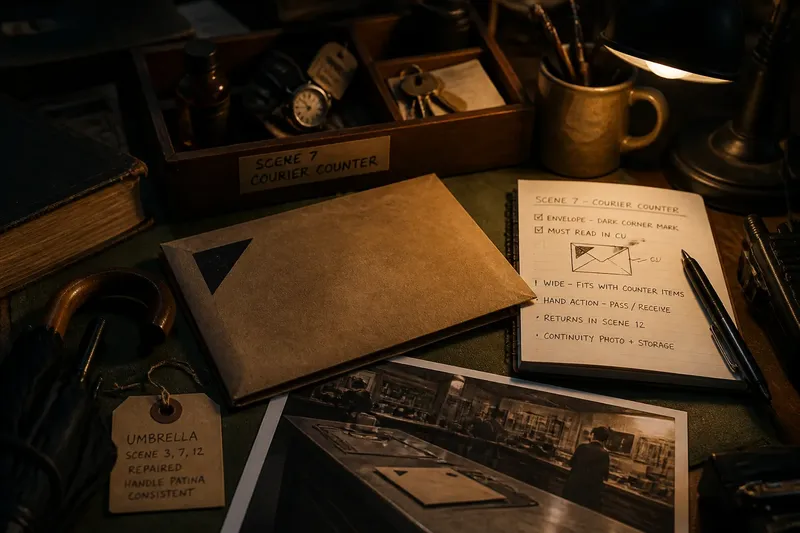
Say a fictional courier scene begins with a crowded counter, a plain envelope, and a later shot in which the envelope must be identified. The prop designer adds a dark corner mark, photographs the envelope beside the counter items, and checks the mark from the planned close-up angle. The resulting choice is a recognizable envelope that can return in later shots without removing the counter’s ordinary clutter.
Plan continuity and camera
Continuity means keeping visible details consistent between shots unless the story calls for a change. A glass may need the same apparent fill level, a book the same cover orientation, or a torn edge the same shape. Reference photos, labeled storage, and scene notes help the crew restore an item’s position and condition.
If a prop visibly changes during a scene, such as paper tearing or liquid spilling, plan how each take begins and ends. The prop team can prepare versions for different states and record which one belongs in each shot. This makes the change intentional and helps avoid mismatches when the scene is edited.
Camera and lighting affect material choices. A glossy surface may reflect a light or crew member, while small lettering may disappear at a distance. Check important details in the intended framing and coordinate with the cinematographer before settling on a finish.
Separate appearance from function
A prop does not always need to perform every real-world task its appearance suggests. An item used only in the background may need no moving parts; an actor-facing object may need to open, close, or support a repeatable gesture. Decide which functions the shot actually requires, then build or source accordingly.
For weapons, powered devices, or objects used close to performers, follow qualified production guidance and applicable safety requirements rather than improvising. For other props, check that the item supports the action, reads in the frame, and belongs in the scene.
When choosing film props, keep the decision tied to the shot: identify what the audience must see, what the actor must do, and what needs to match later. That simple order helps the team choose a found object, make a focused modification, or commission a design without adding detail the camera cannot use.